 Sean Siborey
Public transportation mode such as bus network serves cities across the globe that moves a lot of people large numbers of people to their destinations. Bus network is thought to help alleviate the pressure of traffic congestion at the most affordable option compared to private transports.
In 2014, Phnom Penh municipality launched public bus service to the public which has grown to more than 13 lines by the time of this writing (Oct 2025). As a permanent resident of Phnom Penh myself, I wonder how accessible the bus are stops in my city, if I were to walk, which has led me to utilise my spatial analysis skills to find out.
Walking accessibility determines how easily ones can reach the nearest bus stop, a determining factor that influences ridership. In this spatial analysis, I examined three ranges of walking distances: 0-5, 5-10, and 10-15 minutes.
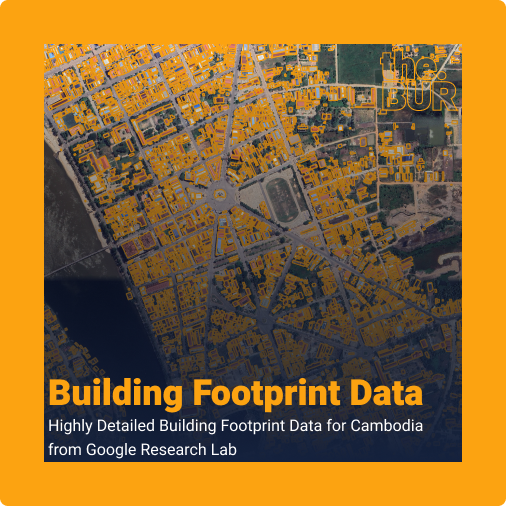
To add more to the analysis, I also extracted Building Footprint data provided by Google Research Lab to find out the number of building distribution and building area coverage within the area categorised by each walking distance zone. Altogether, these spatial layers offer a spatial understanding of how Phnom Penh morphology interacts with the current bus network accessibility.
Data and Methodology
Data Sources
The analysis combined three main datasets:
- Bus Stop Locations – Extracted from Google Map and crossed reference its accuracy with the official Phnom Penh Bus mobile application.
- Road Network – Provided by OpenStreetMap and used as the based for stimulating walking routes and traveling times.
- Building Footprints – Downloaded from Google Research Lab’s Global Building Footprints datasets, representing all built structures within the city.
Tool and Approach
This analysis was performed using open-sourced GIS software called Quantum GIS or QGIS. Using Network Analysis tools to simulate walking catchments. Walking time was estimated at an average speed of a person – 5-minutes walking equals to 330 meters, 10-minutes walking equals to 670 meters, and 15-minutes walking equals to 1 kilometre.
Using these assumptions, service area polygons were generated around each bus stops to represent zones reachable within 5, 10, and 15 minutes of walking.

These polygons were then overlaid with the processed Building Footprint layer to extract two forms of insights:
- Number of buildings reachable within each walking zones.
- Total building area (square metres) within each zone.

Accessibility Classification
To interpret the results meaningfully, the walking-zones were categorised into three levels of accessibility:

| Zone | Walking Time | Accessibility Level | Description |
| Zone 1 | 0-5 minutes | Easily Accessible | Comfort walks; well-served areas |
| Zone 2 | 5-10 minutes | Accessible | Acceptable walking distance; moderately served |
| Zone 3 | 10-15 minutes | Least Accessible | Limited access to public bus stops; fringe areas |
Building Distribution in Relation to Walking Time
This analysis counted how many individuals building fall within each walking zone. This finding shows that:
- Zone 1 (5 minutes): there are more than 150000 buildings located within this zone. The number is significantly lower than zone 2.
- Zone 2 (10 minutes): Almost 35000 buildings is within zone 2, more than twice the number of buildings in zone 1. This figure shows that the bus stops of Phnom Penh city is within the acceptable walking distance to most of the people.
- Zone 3 (15 minutes): There is not a sharp increase in buildings within this zone. However, it indicates the potential of bridging this gap with future expansion of bus network.

Beyond the total built structures within those zones, the total building area (sum of building footprint sizes) within each zone was also calculated. This helps indicate where the bulk of built-up land – likely population or economic activity – is located relative to bus stop accessibility.
In the same vein, the noticeable portion of total building area lies within the acceptable walking distance of 5-10 minutes of walking. Meaning that more population in Phnom Penh live within the accessible walking distance to bus stop – making Phnom Penh a friendly city for public transportation. It signals the future potential of this city for human-friendly and climate-friendly city.

Urban Morphology
Zooming out to view Phnom Penh in its entirety reveals that many areas of the city remain beyond walking distance from any bus stop—a consequence of its organically evolved urban layout. This underscores the critical need for land use planning that integrates transportation accessibility. While the city’s compact size makes municipal bus service a viable option, numerous isolated and fragmented road networks impede pedestrian mobility and limit efficient access to public transit.

Limitation
|
Data Limitation |
Possible Solution |
|
The methodology outlined above assesses public transport service solely through proximity analysis to transport stops, without considering the temporal dimension related to service availability. Additional factors—such as affordability, safety, and universal accessibility—may also significantly affect public transport usage. |
Incorporating temporal aspects is essential for accurately measuring accessibility, as a service located within walking distance may not be practically available if waiting times exceed an acceptable threshold. Collecting more comprehensive data is necessary to evaluate how qualitative aspects influence both access to and utilization of public transport. |
|
The process of correcting bus stop location data is limited by desk research constraints. Bus stop locations in Phnom Penh were obtained from Google Maps and cross-referenced with the official Phnom Penh Bus mobile application. However, inconsistencies exist between these sources in terms of station names and exact locations, with the official app displaying some inaccuracies compared to Google Maps. |
Field verification of each bus stop location is recommended to resolve discrepancies. Although this approach is time-intensive, it will greatly enhance the reliability of the dataset. |
|
The road segment dataset currently lacks attributes that allow for selection of streets accessible to pedestrians, as the road network has not been incorporated into accessibility measurements. |
A comprehensive road network database is needed to effectively quantify access to transport stops. It is also important to assess walking accessibility, including the presence of pedestrian infrastructure such as pavements. Walking distance should be calculated using the street network, taking into account variables such as network density and obstacles (e.g., streams, steep slopes, major roads, or railroads) that may hinder pedestrian movement. |
References
Building Footprint Data: Google Research Lab
Road Network: OpenStreetMap
Bus Stop Data: Google Map and Phnom Penh Bus Mobile Application
GIS Platform: QGIS
Interactive Web Map: Leaflet